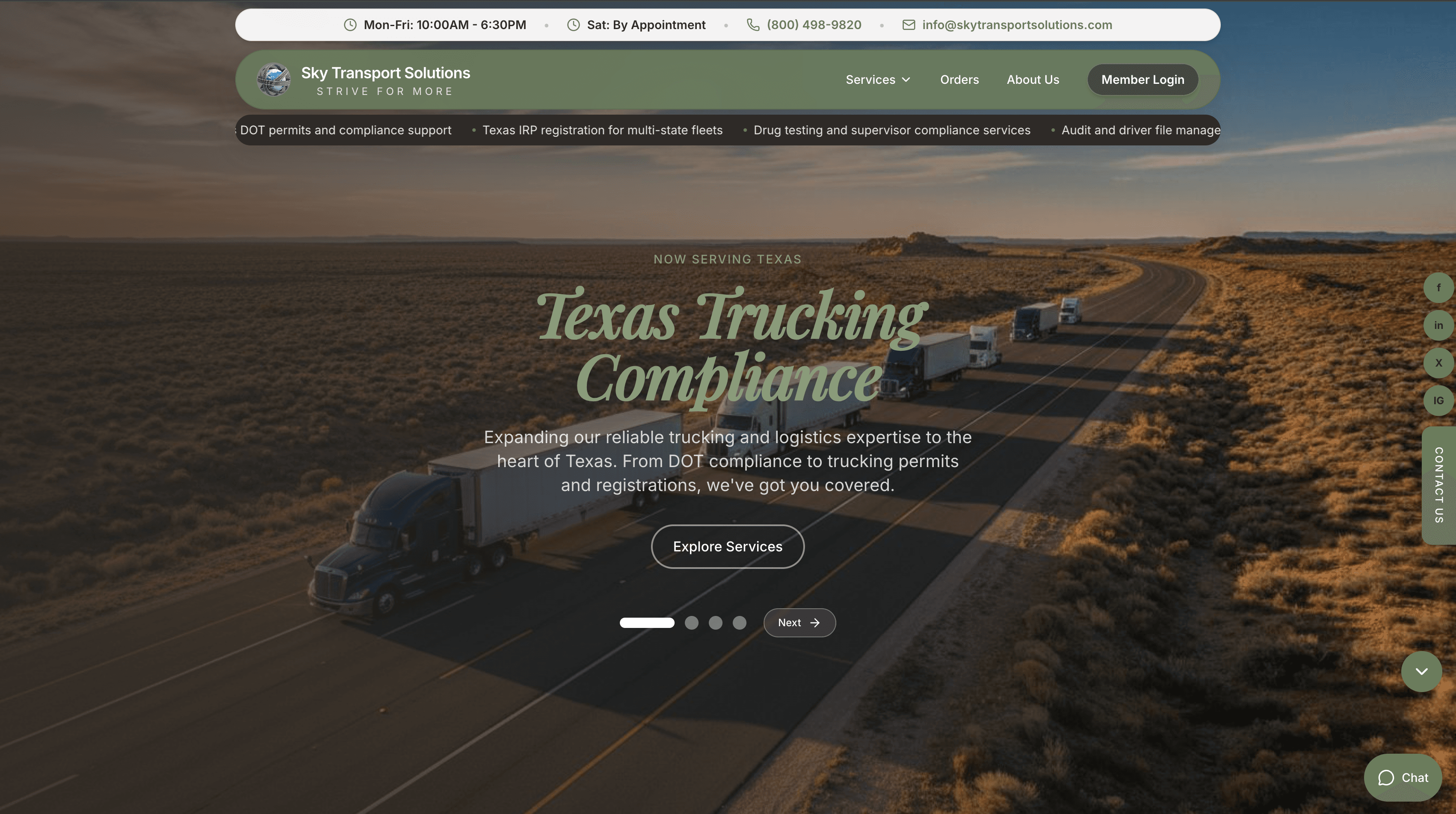
Problem and Constraints
Compliance-focused landing experiences often overload users with dense legal context without guiding action.
- Compliance information needed to stay trustworthy while remaining conversion-friendly.
- Long-form content had to stay readable on mobile without losing structure.
- The site had to ship quickly to production for a live client business.
My Approach
Considered: I considered a content-heavy page that prioritized complete legal detail first.
Chose: I chose a trust-first conversion hierarchy with progressive disclosure and clear CTA checkpoints.
Rejected: I rejected dense top-loaded copy because it increases drop-off before users reach action points.
Considered: I considered section-by-section custom components for each content block.
Chose: I chose reusable page primitives to keep layout consistency and faster iteration.
Rejected: I rejected one-off components because they slow refinement and fragment visual hierarchy.
Considered: I considered desktop-first spacing and then mobile adaptation.
Chose: I chose mobile-first section rhythm to preserve readability in the longest flows.
Rejected: I rejected desktop-first tuning because compliance pages are often consumed on phones.
System Design
Loading diagram…
The page system intentionally sequences context, trust, and service clarity before asking for action. That ordering lowers cognitive load for compliance-heavy audiences and makes conversion points feel safer to engage.
Implementation Highlights
- Structured hero-to-CTA page flow with conversion-oriented section hierarchy.
- Clear content blocks for service framing, trust anchors, and action routing.
- Responsive layout tuned for mobile-first readability in long-form sections.
- Deployment-ready implementation for live site operations.
Tech Stack
Outcomes
- Delivered a stable production interface with clear information flow.
- Improved section readability and CTA placement for practical user journeys.
- Strengthened my workflow for shipping polished business-facing pages quickly.
Retrospective
Problem: Long compliance content can lose users if structure is unclear.
What I tried: I organized content into progressive sections and clear CTA checkpoints to reduce cognitive load.
What I'd do differently: I would add richer instrumentation for section-level engagement to tune conversion copy faster.